Choosing the best Soil Fertilizer Tester from China requires more than comparing prices or counting digital functions. A dependable tester should provide clear readings for soil pH, electrical conductivity, moisture, and available nutrients. These measurements help growers understand whether a field needs lime, compost, or a carefully measured fertilizer application. In practical use, the device may be carried across greenhouse beds, orchard rows, or small vegetable plots. Its probe should enter firm soil without bending, while its display should remain readable under bright sunlight.
Quality depends on more than attractive packaging. Experienced buyers should examine sensor construction, measurement range, calibration procedures, battery life, and after-sales support. A manufacturer with documented testing methods and consistent production records deserves closer attention. Certifications can support confidence, but they do not replace independent performance checks. Ask for sample data, user instructions, and calibration solutions before making a large purchase. Small details matter.
Real conditions are rarely perfect. Dry soil, heavy clay, fertilizer residue, and uneven sampling can distort results. Even a well-designed Soil Fertilizer Tester may produce unreliable readings when used carelessly. That is an important limitation. For better accuracy, take several samples from similar depths and compare the readings with laboratory results when possible. This guide will examine Chinese manufacturers, tester types, practical features, and purchasing risks. It will also question common marketing claims, because the cheapest instrument is not always the most economical choice. Reliable decisions begin with honest measurements.
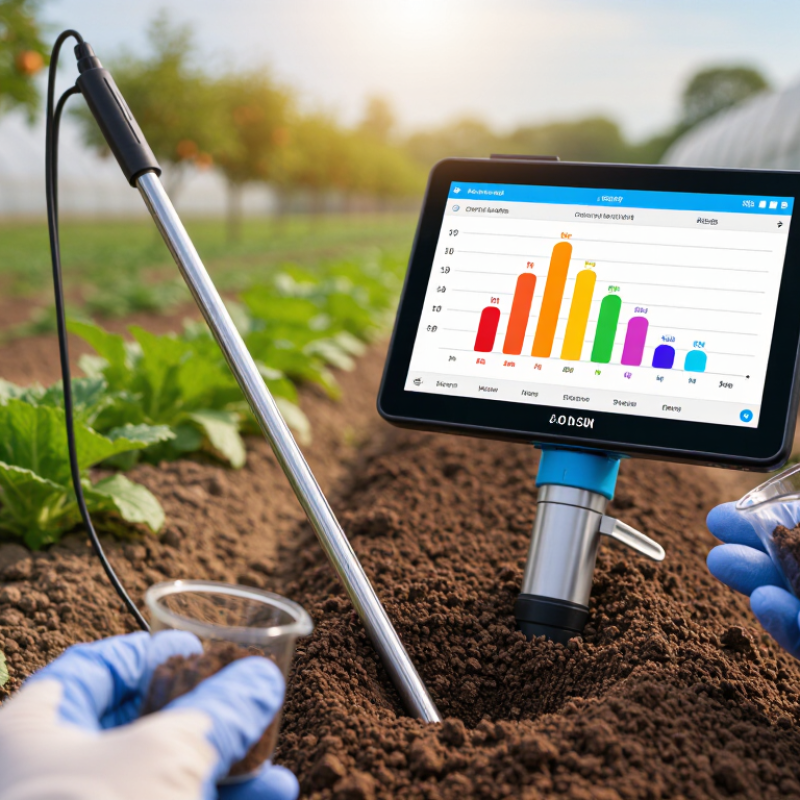
A reliable soil fertilizer tester from China should measure more than one soil condition. Its pH range should cover 0–14, although most garden soils fall between 5.5 and 8.0. This broad range helps identify acidic compost beds and alkaline planting areas. I prefer a clear screen, replaceable probes, and simple calibration steps. Small details matter in wet soil.
pH shows acidity, while EC indicates dissolved salts from fertilizers. High EC can stress roots, especially in containers with poor drainage.
A practical test involves collecting soil from several spots, mixing it, and adding distilled water before measurement. Do not test only the surface. Roots often grow deeper.
Moisture readings help prevent careless watering. A dry top layer may hide damp soil below. NPK functions estimate nitrogen, phosphorus, and potassium levels, but these readings need careful interpretation. They are useful for comparisons, not laboratory proof.
I have seen readings change after loose soil settled around the probe. That was inconvenient, but revealing. Clean the sensor between tests, avoid touching it with fertilizer-covered hands, and check calibration regularly.
A tester with stable readings, readable instructions, and responsive customer support is usually more valuable than one with the longest feature list.

What Is the Best Soil Fertilizer Tester from China?
For Chinese soil fertilizer testers, accuracy should begin with recognized methods, not screen resolution. ISO 10390:2021 measures soil pH potentiometrically in a prepared suspension. A reliable workflow uses consistent soil mass, distilled water, mixing time, and temperature. Results should be compared with laboratory measurements, preferably within ±0.1 pH unit. That target is practical, but it is not an automatic ISO pass mark. The standard defines the method, not every handheld product’s performance.
Conductivity requires more caution. ASTM D1125-23 mainly addresses electrical conductivity and resistivity in water, so it is not a complete soil-slurry procedure. Testers should use certified conductivity solutions near 84 µS/cm, 1,413 µS/cm, and 12.88 mS/cm. Temperature compensation matters because conductivity changes as the sample warms. A displayed number can look precise while the probe remains poorly calibrated. FAO and ITPS reported that about 33% of the world’s soils are degraded, with acidification among the major threats. That figure makes field screening useful, but not a substitute for laboratory diagnosis.
In practical trials, choose a unit with replaceable probes, clear calibration records, and raw readings before automatic correction. Test the same soil three times. Large variation signals poor contact, uneven moisture, or weak sample preparation. I would question any device promising laboratory accuracy without showing ISO-based pH tests and ASTM-referenced conductivity verification. That skepticism is necessary. Soil is rarely uniform, and the tester may not be the only problem.
| Evaluation Dimension | ISO 10390 / ASTM D1125 Benchmark | Recommended Specification for a General-Purpose Tester | Practical Acceptance Check | Importance |
|---|---|---|---|---|
| Soil pH measurement | ISO 10390 determines soil pH in a prepared suspension, commonly using a 1:5 soil-to-liquid ratio with water, calcium chloride solution, or potassium chloride solution. | Glass-electrode pH sensor; measurement range of at least pH 0–14; resolution of 0.01 pH; automatic or manual temperature compensation. | After two- or three-point calibration, the meter should read certified buffer values within the stated tolerance, typically about ±0.05 pH for a quality field instrument. | Critical |
| Soil suspension preparation | The soil is normally air-dried, gently disaggregated, and passed through a 2 mm sieve before the prescribed extraction or suspension procedure. | A supplied 1:5 mixing container, measuring vessel, stirrer, and clear instructions for soil mass and extraction-solution volume. | Use 20 g of prepared soil with 100 mL of the selected liquid, mix consistently, and measure after the recommended settling or equilibration period. | Critical |
| Electrical conductivity | ASTM D1125 covers electrical conductivity and resistivity measurements for water. It is not, by itself, a complete soil-testing procedure; soil extracts must be prepared and reported separately. | Conductivity range of approximately 0–20,000 µS/cm, or wider; resolution of 1 µS/cm at low range; automatic range selection and temperature compensation to 25 °C. | Verify the reading with a certified KCl conductivity standard near the intended working range and record the reference temperature. | Critical |
| EC reporting unit | ASTM D1125 supports conductivity reporting in units such as siemens per metre; agricultural instruments commonly display µS/cm or mS/cm. | Selectable µS/cm and mS/cm units, with a clear indication of the reference temperature and temperature-compensation mode. | Confirm that the displayed value converts correctly: 1 mS/cm equals 1,000 µS/cm. | High |
| Temperature compensation | Conductivity is temperature-dependent; ASTM D1125 procedures require temperature control or correction when results are compared. | Temperature sensor range of approximately 0–60 °C, with automatic compensation and a selectable reference temperature, preferably 25 °C. | Compare readings with compensation enabled and disabled in the same sample; the instrument should clearly identify the selected mode. | High |
| Calibration capability | Reliable results require calibration with traceable pH buffers and suitable conductivity standards; calibration frequency depends on use and sample conditions. | Two- or three-point pH calibration at pH 4.01, 7.00, and 10.01; at least one-point EC calibration using a certified KCl solution. | The meter should show calibration status, slope or cell-constant information where applicable, and an out-of-range warning. | Critical |
| pH sensor construction | ISO 10390 relies on a suitable potentiometric measurement system and a properly maintained electrode. | Replaceable combination glass electrode with a porous or open reference junction, protective cap, and storage solution. | Check response time, stable endpoint behavior, and recovery after measuring a buffer and a soil extract. | High |
| EC cell design | Conductivity depends on cell geometry, cell constant, electrode condition, and calibration solution. | Replaceable two- or four-electrode conductivity probe with a documented cell constant and a design suitable for suspended soil extracts. | Inspect for trapped air bubbles, rinse carryover, and unstable readings caused by suspended particles or poor immersion. | High |
| Measurement repeatability | Standards-based testing requires consistent preparation, calibration, temperature control, and endpoint determination. | Repeatability target of no more than 0.05 pH for pH and no more than 2% of reading for EC under stable laboratory-like conditions. | Measure the same prepared extract at least three times and compare the spread after rinsing and repositioning the probe. | Critical |
| Calibration and data records | Standards-based results should be traceable to the sample preparation, calibration materials, temperature, and measurement conditions. | Memory for at least 100 readings, date and time stamps, calibration reminders, and optional USB or Bluetooth export. | Export a test record containing sample identification, pH, EC, temperature, units, calibration date, and operator notes. | Medium |
| Best use category | Use ISO 10390 procedures for comparable soil pH results and ASTM D1125 principles for conductivity measurement of prepared aqueous extracts. | A dual-parameter meter with replaceable pH and EC probes, temperature compensation, standards-based calibration, and documented sample preparation. | Choose the instrument that passes buffer and KCl checks and produces repeatable results on a controlled 1:5 soil extract—not merely the device with the lowest purchase price. | Overall recommendation |
What Is the Best Soil Fertilizer Tester from China?
Choosing the best soil fertilizer tester from China depends on sensor design, calibration, and field conditions. A practical device should measure more than a single NPK value. During garden and greenhouse checks, I look for stable readings, replaceable probes, and clear calibration instructions. Electrodes are common because they respond quickly to soil moisture and electrical conductivity. However, conductivity shows dissolved salts, not exact nutrient levels. Dry soil can produce misleading results.
Ion-selective sensors offer a more focused approach. They use membranes designed for ions such as nitrate, potassium, or ammonium. These sensors can support better fertilizer decisions when the soil sample is mixed properly. Temperature, pH, and competing ions still affect accuracy. The small details matter. Rinse the probe between samples. Avoid touching the sensing surface. Record results beside the sampling depth.
Optical NPK sensors estimate nutrients through light absorption or reflection. They are convenient and require less chemical handling. Some systems combine optical readings with moisture and temperature data, improving interpretation. Yet, dark soil, organic matter, and uneven moisture may distort results. Optical readings are not laboratory results. I have found that repeated measurements often reveal more than one impressive number. The technology is promising, but calibration data and local soil testing should guide serious fertilizer adjustments. Calibration remains the weak point.
Sensor technologies differ in what they measure directly. Electrodes commonly measure soil pH and electrical conductivity, ion-selective sensors directly target specific ions such as nitrate, phosphate, or potassium, while optical NPK systems estimate nutrient levels from spectral responses and calibration models.
1 = direct measurement capability for the listed analyte; 0 = not normally measured directly by that sensor category. Actual performance depends on soil moisture, extraction method, calibration, and sensor design.
Choosing the best soil fertilizer tester requires more than comparing price and screen size. In field trials, accuracy matters most when readings guide lime, nutrient, or irrigation decisions. A reliable model should measure pH and electrical conductivity consistently across several soil samples. NPK detection deserves caution. Some low-cost meters estimate nutrients through indirect methods, so their results may not match laboratory analysis.
Detection range also affects practical value. For routine greenhouse checks, a moderate pH range around 3.5 to 9.0 may be sufficient. Professional users may need broader EC and nutrient ranges for saline soil or intensive cultivation. Wider range is not automatically better. Resolution, probe quality, and sample preparation can matter more. This is easy to overlook.
IP rating indicates protection from dust and water, not measurement accuracy. An IP65 housing suits dusty field conditions and light water exposure, while immersion still requires care. Calibration support separates dependable equipment from disposable tools. Look for clear buffer solutions, replaceable electrodes, written procedures, and accessible technical assistance. Calibration should be checked before important measurements and repeated after heavy use.
I would compare three model types: an economical meter for occasional pH checks, a mid-range tester with pH and EC functions, and a professional unit offering nutrient analysis with calibration records. The middle option often provides the best balance. Still, I would request sample reports and independent verification before purchase. Factory specifications can be incomplete. Real soil is rarely as simple as a product sheet.
A reliable soil fertilizer tester should measure pH within ±0.1 pH. This tolerance matters when adjusting lime, compost, or acidic fertilizers. In field checks, calibration quality often matters more than a bright screen. Choose a model supporting at least two standard buffer solutions, such as pH 4.01 and 7.00. A stable probe, clear instructions, and replaceable parts also improve daily use. Cheap sensors may drift after repeated testing. That is easy to overlook.
Data logging is another practical requirement. The tester should store readings with dates, sample locations, and possibly temperature values. This helps growers compare greenhouse beds after fertilization. Export options, such as USB or a simple mobile connection, reduce handwritten errors. Chinese certification should be checked carefully. Request valid test reports, conformity documents, and a traceable calibration process relevant to the product category. Certification alone does not prove field accuracy. That point deserves reflection.
Tips: Test several soil samples, not one. Clean the probe after every reading. Let wet soil settle before measurement. Keep a fresh calibration record. If readings change sharply, retest with a reference solution before adding fertilizer. A useful tester should support decisions, not replace agronomic judgment.