Choosing China’s top Welded Pipe manufacturers requires more than comparing prices on a supplier directory. Global buyers need evidence of production capability, material control, testing discipline, and dependable export experience. A serious manufacturer should explain its pipe forming process, welding method, steel grade, dimensional tolerances, and surface treatment clearly. Factory photographs help, but they do not replace audit records, inspection reports, or traceable material certificates.
Details matter. During a factory evaluation, buyers may review coil storage, automated welding lines, ultrasonic testing stations, and hydrostatic pressure equipment. They should also ask how defects are recorded and corrected. Reliable suppliers usually provide samples, inspection plans, packing photographs, and realistic lead times. Their answers should remain consistent from the sales team to the quality department. That assumption can fail. Some factories present strong capabilities but outsource important steps without clear disclosure.
This guide examines Chinese manufacturers through a practical, buyer-focused lens. It considers product range, manufacturing experience, quality systems, customization support, communication, and after-sales responsibility. International standards may guide purchasing decisions, yet certification alone does not guarantee consistent performance. Buyers should match each supplier’s equipment and documented experience with the project’s pressure, transport, coating, and installation requirements. The strongest choice is not always the largest factory. It is the manufacturer that can prove suitable performance, communicate limitations honestly, and deliver repeatable quality across every shipment.
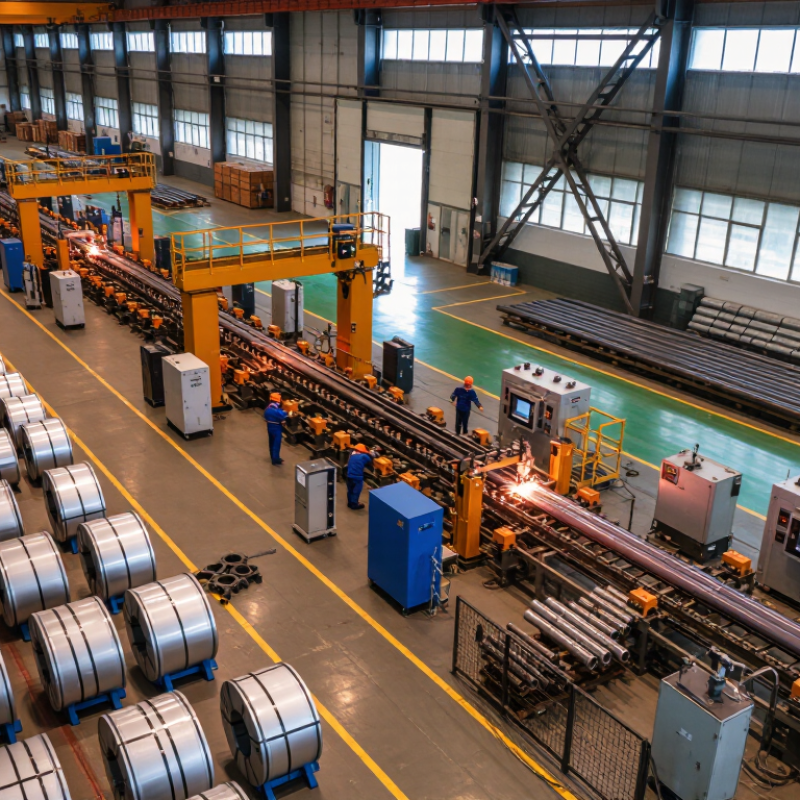
China’s welded pipe manufacturing combines large steel capacity with flexible fabrication lines. The World Steel Association reported 1.019 billion tonnes of crude steel production in China during 2023. This scale supports stable coil sourcing, but it does not guarantee consistent pipe quality.
Manufacturers typically uncoil steel, level it, form it, weld the seam, size the pipe, and inspect the surface. High-frequency welding suits many structural and fluid-service applications. Spiral submerged arc welding supports large diameters and long lengths. Operators monitor weld temperature, line speed, and edge alignment. Small deviations matter. A slight mismatch can create later pressure-test failures.
For international projects, buyers commonly specify ISO 3183 or API 5L for line pipe, while GB/T 9711 remains important in domestic supply chains. Inspection may include ultrasonic testing, hydrostatic testing, dimensional checks, and mechanical testing. ISO 9001 systems can improve traceability, but paperwork alone is not proof of process control. Ask for heat numbers, mill certificates, weld inspection records, and sample test results. The OECD’s steel market reports continue to highlight overcapacity and trade pressure, so delivery claims deserve careful verification. Some suppliers offer impressive tolerances, yet practical production limits are often less polished than the brochure suggests. Auditing the actual mill is still wiser.

The chart compares the minimum specified yield strength of commonly used API 5L PSL 1 line-pipe grades. ERW, LSAW, and SSAW production lines may manufacture different grades depending on plate or coil quality, welding control, heat treatment, dimensional inspection, and final testing. Values are shown in MPa.
Reference basis: API Specification 5L minimum yield-strength requirements for PSL 1 grades.
Welded pipes differ mainly by forming method, weld position, and service duty. Electric resistance welded (ERW) pipes suit water, structural, and low-to-medium pressure systems.
Longitudinal submerged arc welded (LSAW) pipes offer thicker walls and strong dimensional control.
Spiral submerged arc welded (SSAW) pipes efficiently support large diameters. They often serve water transmission and lower-pressure infrastructure.
The World Steel Association reported 1.89 billion tonnes of crude steel production in 2023. This scale supports broad welded-pipe supply, but steel volume alone does not prove pipe quality.
API 5L line-pipe requirements guide many oil and gas projects, while ASTM A53 commonly covers general mechanical and pressure applications.
ERW pipe can be practical for building columns, firewater lines, and compressed-air systems.
LSAW pipe is more suitable for buried transmission lines and large industrial headers. Spiral Welded Pipe often appears in municipal water mains, where diameter and installation cost matter.
Selection should consider corrosion, wall thickness, weld inspection, coating, temperature, and operating pressure. A factory inspection should review ultrasonic testing, hydrostatic testing, and heat-number traceability.
Reports from Grand View Research forecast continued welded-pipe market growth through 2030, driven by construction, utilities, and energy projects. Forecasts are not invoices. Project conditions can change quickly.
A cheaper large-diameter pipe may create higher coating, transport, or maintenance costs. That trade-off deserves closer review.
China remains a major sourcing base for welded pipe. The World Steel Association reported 1,019.1 million tonnes of Chinese crude steel production in 2023, about 54% of global output. Scale matters, but it does not prove consistent pipe quality. Buyers should examine mill capacity, welding processes, raw-material sources, and export experience. Ask for recent inspection records, not only catalog claims. ISO 9001 certification helps, but it cannot replace product testing.
Check whether the manufacturer can meet the required standard, such as ASTM A53, API 5L, EN 10217, or EN 10219. Confirm outside diameter, wall thickness, length tolerance, coating, and hydrostatic testing. Request mill test certificates linked to heat numbers. Independent inspection should verify chemical composition, tensile strength, weld integrity, and dimensional accuracy. A factory tour can reveal practical details, including pipe storage, calibration equipment, and how finished bundles are protected from rain. Photos can be selective. That is an uncomfortable limitation.
Tips: Compare three technical quotations. Separate steel price, testing, coating, packaging, and freight. Check whether certificates are traceable to each batch. Request a sample inspection before full production. Read the rejection procedure carefully. A cheap offer may hide weaker controls, but a higher price is not automatic proof of reliability. Review evidence, not confidence.
Quality control begins with traceability, not attractive packaging. Reliable manufacturers mark each pipe bundle with heat numbers, dimensions, wall thickness, and production dates. Inspectors should compare these details with material test certificates and purchase specifications. Weld seams require visual checks, dimensional inspection, and suitable non-destructive testing. Hydrostatic testing may also apply to pressure-service orders. Small records matter.
Certifications need careful verification. ISO 9001 can show a documented quality system, but it does not prove every pipe meets your project standard. Request current certificates, laboratory reports, and an EN 10204 3.1 inspection document when required. For special applications, confirm the applicable technical standard before production. A certificate copied from an old order is not useful.
Export compliance covers more than customs paperwork. The supplier should provide an accurate commercial invoice, packing list, certificate of origin, and correct HS classification. Product descriptions, quantities, and declared values must match the shipment. Check marking, packaging, destination requirements, and any required third-party inspection. One overlooked heat number can delay clearance. It happens. Buyer review still matters, even when a factory appears experienced. Keep approved drawings, inspection records, photographs, and shipping documents together for future claims.
Global buyers should source welded pipe by application, not by price alone. In practical procurement reviews, clear drawings reduce costly revisions. Specify outside diameter, wall thickness, steel grade, weld standard, coating, length tolerance, and inspection documents. The World Steel Association reported global crude steel production of about 1.89 billion tonnes in 2023. That scale supports broad supply, but it does not guarantee consistent pipe quality. A mill certificate is only useful when its heat number matches the delivered bundle.
Pricing should separate steel, forming, welding, finishing, testing, packing, and inland transport. Ask for both ex-works and delivered quotations. Steel prices can move before a purchase order becomes production. OECD steel data also shows continuing pressure from global capacity expansion. Buyers should therefore compare validity periods carefully. A cheap offer may hide thinner walls, weaker coating, or limited inspection. That mistake is easy to make.
Logistics needs equal attention. UNCTAD reports that maritime shipping carries over 80% of global merchandise trade by volume. Yet long pipe is not always suitable for containers. Bundled cargo may require breakbulk or specialized flat-rack handling. Confirm bundle weight, lifting points, port restrictions, demurrage terms, and cargo insurance. The World Bank’s 2023 Logistics Performance Index highlights wide differences in customs and delivery reliability between markets. Build buffer time. It is not elegant, but delays happen. One planning weakness deserves reflection: buyers often calculate freight to the port, while project costs continue after discharge.
| Product Category | Typical Manufacturing Process | Common Size Range | Typical Wall Thickness | Common International Standards | Typical Steel Grades | Indicative FOB Price (USD/metric ton) | Typical Production Lead Time | Practical Order Quantity | Typical Export Packaging | Best-Fit Applications |
|---|---|---|---|---|---|---|---|---|---|---|
| ERW Carbon Steel Pipe | Electric resistance welding using longitudinally formed steel strip or coil | Outside diameter: 21.3–610 mm | 2.0–16 mm | ASTM A53, API 5L, EN 10217-1, ISO 3183 | Gr. B, X42, X52; S235 and S355 equivalents | 650–950 | 20–35 days | Usually 20–100 metric tons | Steel straps, end protectors, seaworthy bundles, optional plastic wrapping | Water lines, structural work, low- and medium-pressure service, general fabrication |
| HFW Line Pipe | High-frequency welding with controlled edge heating and online sizing | Outside diameter: 219–610 mm | 6–16 mm | API 5L, ISO 3183, EN 10217-1 | X42, X52, X60; L290 and L360 equivalents | 700–1,000 | 25–45 days | Usually 100–500 metric tons | Bundled with steel straps; beveled ends and coating protection when specified | Oil and gas gathering lines, water transmission, industrial pipelines |
| Spiral Submerged Arc Welded Pipe | Helical forming followed by submerged arc welding on the inside and outside seams | Outside diameter: 219–3,500 mm | 6–25 mm | API 5L, AWWA C200, ISO 3183, EN 10217-1 | Grade B, X42, X52, X60; S355 equivalents | 620–900 | 30–55 days | Usually 200–2,000 metric tons | Unbundled or bundled by diameter; end caps and external coating protection | Large-diameter water transmission, piling, slurry lines, irrigation systems |
| Longitudinal SAW Pipe | Plate forming with longitudinal submerged arc welding, commonly used for high-strength applications | Outside diameter: 406–1,422 mm | 8–40 mm | API 5L, ISO 3183, ASTM A252, EN 10217-1 | X52, X60, X65; S355 and S420 equivalents | 700–1,100 | 35–60 days | Usually 300–3,000 metric tons | Heavy-duty bundles, lifting points, end protection, optional anti-corrosion coating | Transmission pipelines, offshore structures, bridge piles, heavy engineering |
| Galvanized Welded Pipe | ERW pipe followed by hot-dip galvanizing or pre-galvanized strip processing | Outside diameter: 15–219 mm | 1.5–8 mm | ASTM A53, ASTM A795, EN 10255, ISO 1461 | Gr. A, Gr. B; S235 and S275 equivalents | 850–1,250 | 25–45 days | Usually 20–200 metric tons | Strapped bundles, waterproof paper or plastic wrapping, threaded ends when required | Fire sprinkler systems, scaffolding, fencing, greenhouse frames, construction services |
| Structural Hollow Section | Cold-formed ERW production into round, square, or rectangular hollow sections | Round: 21–610 mm Square: 20–500 mm Rectangular: 20×30–500×300 mm | 1.5–25 mm | ASTM A500, EN 10219, JIS G3466 | Grade B and C; S235, S275, S355 equivalents | 650–1,000 | 20–40 days | Usually 20–300 metric tons | Steel-strapped bundles with corner protection and optional black or galvanized finish | Buildings, mechanical frames, agricultural structures, towers, and machinery supports |
| Oil- and Gas-Service Welded Pipe | ERW or SAW production with non-destructive testing and documented heat traceability | Outside diameter: 219–1,422 mm | 6–40 mm | API 5L, ISO 3183, customer-specific project specifications | X52, X60, X65, X70 | 750–1,250 | 45–75 days | Usually 500–5,000 metric tons | Project-specific coating, beveling, marking, end caps, and inspection documentation | Pipeline projects requiring hydrostatic testing, NDT, traceability, and third-party inspection |
| Stainless Steel Welded Pipe | Longitudinal TIG, laser, or high-frequency welding with pickling and passivation options | Outside diameter: 6–1,600 mm | 0.6–20 mm | ASTM A312, ASTM A358, EN 10217-7, ASME SA312 | 304/304L, 316/316L, 321, 904L | 2,300–4,500 | 35–60 days | Usually 5–100 metric tons | Plastic sleeves, plywood or seaworthy crates, capped ends, and moisture protection | Chemical processing, food equipment, pharmaceuticals, water treatment, and marine service |