Global sourcing of Power Tool Accessories requires more than comparing unit prices. Buyers must assess fit, material quality, safety documentation, packaging, and supply continuity. A drill bit that looks identical online may differ in carbide grade, coating thickness, shank accuracy, and tested lifespan. Small differences become visible on a factory floor.
Industry data supports careful planning. Grand View Research estimates that the global power tools market reached approximately USD 46 billion in 2023 and will continue expanding through 2030. Its analysis highlights construction, manufacturing, and home improvement as major demand areas. The Freedonia Group also identifies replacement demand and professional jobsite use as important market drivers. These trends create opportunities, but they also increase sourcing pressure. More suppliers does not always mean better suppliers.
Steve Richman, former president of the Power Tool Institute, has emphasized, “Read and follow the manufacturer’s instructions before using any power tool or accessory.” That advice applies to sourcing, too. Specifications must be checked before commercial negotiation. Ask for test reports, batch records, dimensional drawings, and samples from actual production. Inspect the accessory after drilling, cutting, or fastening—not only after opening the box.
This guide examines supplier evaluation, compatibility, certification, logistics, and total cost. It is not flawless. Product categories overlap, and regional standards change. Buyers should verify current requirements with qualified testing bodies and local compliance professionals. A cheaper accessory can become expensive through returns, downtime, or damaged equipment. In global sourcing, reliability is the real specification.
Global sourcing works better when accessory requirements are defined before supplier discussions begin. Start with the job. Identify the tool type, operating speed, torque range, material, and working environment. A masonry drill bit needs different hardness and geometry from a wood-cutting blade. Write these details in a measurable specification, not vague terms like “premium quality.”
Our sourcing team once requested a universal accessory set. That assumption failed. The set looked convenient, but several pieces performed poorly under repeated load. We now separate must-have requirements from optional features. Must-haves may include dimensional tolerance, shank compatibility, heat resistance, service life, and safe packaging. Optional features could include storage cases or color coding. This distinction controls cost without weakening performance.
Ask suppliers for test reports, production samples, inspection records, and material information. Compare samples under realistic conditions, such as dusty workshops, long drilling cycles, or uneven surfaces. Check whether markings remain readable after handling. Confirm packaging protects cutting edges during ocean transport. Requirements should also reflect destination-market safety rules and import documentation. Do not rely on a catalogue image alone. It is easy to overlook fit, labeling, or replacement availability. Our checklists still need revision, especially when field users report problems that laboratory tests miss. Reliability comes from documented evidence, repeatable inspections, and honest communication about limitations.
How to Choose Power Tool Accessories for Global Sourcing?
Matching accessories to the correct tool is the foundation of reliable global sourcing. Start with the tool’s model, chuck type, shank size, thread pattern, and operating speed. A drill bit for a keyed chuck may not fit a quick-change holder. Small differences can cause vibration, poor results, or premature wear.
Match the accessory with the actual use case. Masonry bits need impact resistance, while metal-cutting discs require suitable hardness and heat control. Sanding pads should match the backing system and working diameter. Check material, dimensions, tolerances, and rated speed before requesting samples. My early sourcing mistake was trusting product photos too much. The accessory looked compatible, but its shank was slightly too long. That detail delayed testing.
Tips: Build a compatibility checklist for every purchase. Record tool type, accessory size, connection method, material, and working speed. Ask suppliers for technical drawings and test reports. Inspect samples under real conditions, not only on a clean factory bench. Use the same test material each time, such as a fixed steel plate or concrete block. Compare cutting time, surface quality, heat, and wear. Leave room for judgment. Specifications can be correct, yet the accessory may feel unsuitable during continuous work. Regional users may also prefer different sizes or performance levels, so feedback from local operators remains valuable.
| Accessory Category | Common Interface or Shank | Compatible Tool Class | Typical Materials and Use Cases | Key Compatibility Checks | Important Sourcing Specifications | Safety and Performance Notes |
|---|---|---|---|---|---|---|
| Twist Drill Bits | Round shank; commonly 1/4 in, 3/8 in, or 1/2 in chuck capacity depending on bit size | Cordless or corded drills and drill drivers | Unalloyed steel, aluminum, wood, and plastic; general-purpose drilling | Chuck capacity, bit diameter, drilling depth, rotation direction, and speed range | High-speed steel grade, point angle, flute length, overall length, surface treatment, diameter tolerance, and set configuration | Use cutting fluid when recommended for metal; avoid excessive pressure and overheating |
| Masonry Drill Bits | Round shank or quick-change shank; some versions use specialized hammer-drill interfaces | Drills with rotary or hammer-drilling modes | Brick, concrete block, mortar, and light concrete; anchor-hole preparation | Hammer-mode suitability, shank diameter, hole diameter, maximum drilling depth, and tool chuck system | Carbide tip grade, brazing quality, flute design, diameter range, length, and impact resistance | Wear eye and respiratory protection; do not use rotary-only bits for reinforced concrete unless specified |
| Driver Bits | 1/4 in hex shank | Drill drivers, impact drivers, and manual bit holders with matching receptacles | Wood, sheet metal, plastics, and general fastening; Phillips, slotted, hex, Torx-type, and square recesses | Bit profile, impact rating, holder retention, screw recess, and required torque level | Alloy steel, hardness range, torsion-zone design, bit length, coating, tip precision, and packaging assortment | Use impact-rated bits in impact drivers; worn tips can damage screw recesses |
| Hole Saws | Arbor-mounted system with pilot drill; arbor shank must match the chuck | Drills and drill drivers; low-speed operation is commonly required | Wood, plastic, drywall, thin sheet metal, and selected masonry products | Arbor type, cutting diameter, cutting depth, pilot-bit size, material suitability, and tool speed | Bi-metal or carbide-grit construction, tooth form, wall thickness, arbor compatibility, replacement parts, and diameter range | Secure the workpiece; use controlled feed pressure and remove the core safely |
| Circular Saw Blades | Arbor hole sized to the saw spindle; common blade diameters include 165 mm, 184 mm, and 190 mm | Handheld circular saws and compatible table or mitre saws | Softwood, hardwood, plywood, engineered wood, and some non-ferrous metals with dedicated blades | Blade diameter, arbor diameter, maximum revolutions per minute, kerf, guard clearance, and tooth direction | Carbide tooth count, tooth geometry, plate thickness, kerf width, expansion slots, runout, and balance | Never exceed the marked speed rating; select tooth count according to cut speed and finish requirements |
| Reciprocating Saw Blades | Universal reciprocating-saw tang; tang dimensions and locking clearance should be verified | Cordless or corded reciprocating saws | Wood, pruning work, metal pipe, sheet metal, plastics, and demolition applications | Tang fit, blade length, stroke length, stroke rate, material thickness, and cutting direction | Bi-metal or carbon-steel construction, teeth per inch, blade thickness, working length, flexibility, and tooth pattern | Choose coarse teeth for fast wood cutting and finer teeth for thin metal; clamp loose materials |
| Jigsaw Blades | Common T-shank or U-shank designs; the blade holder must match the saw | Orbital or straight-action jigsaws | Wood, laminate, plastics, aluminum, and thin steel sheet | Shank style, blade length, teeth per inch, maximum material thickness, orbital setting, and cutting curve | High-carbon steel or bi-metal construction, tooth direction, progressive tooth pitch, blade width, and finish quality | Use down-cut blades for reduced top-surface splintering where appropriate; support the workpiece |
| Angle Grinder Discs | Arbor hole matched to the grinder spindle; common disc diameters include 100 mm, 115 mm, and 125 mm | Angle grinders with matching disc diameter and speed rating | Cutting or grinding steel, stainless steel, masonry, concrete, and stone with dedicated disc types | Disc purpose, diameter, arbor size, thickness, maximum revolutions per minute, guard compatibility, and material rating | Abrasive type, reinforcement layers, bond hardness, disc thickness, conformity markings, shelf life, and moisture-resistant packaging | Use the correct guard and personal protective equipment; do not use cutting discs for side grinding |
| Sanding Discs and Sheets | Hook-and-loop or pressure-sensitive backing; hole pattern must match the sanding pad | Random orbital sanders, palm sanders, detail sanders, and angle grinders with sanding backing pads | Wood, painted surfaces, plastics, composites, and metal preparation | Pad diameter or shape, hole layout, backing attachment, grit range, tool speed, and dust-extraction openings | Abrasive mineral, grit standard, backing material, coating, anti-clog treatment, edge durability, and pack quantity | Use progressively finer grits; avoid excessive pressure, which can reduce abrasive life and cause surface defects |
| Oscillating Multi-Tool Blades | Open-interface or star-shaped mounting patterns; interface geometry must match the tool holder | Oscillating multi-tools with compatible mounting systems | Flush cutting, plunge cutting, grout removal, scraping, sanding, and detail work in wood, plastic, and metal | Mounting pattern, oscillation angle, blade width, cutting depth, teeth per inch, and tool clearance | Bi-metal or high-carbon steel, carbide grit or carbide teeth, blade thickness, working width, and accessory life | Confirm the blade is fully seated; use lower speed for heat-sensitive materials and controlled plunge pressure |
| Router Bits | Collet shanks commonly sized at 6 mm, 8 mm, or 1/4 in, depending on the router and market | Fixed-base or plunge routers with matching collets | Solid wood, plywood, MDF, and plastic for edging, grooving, trimming, and joinery | Collet diameter, maximum bit diameter, router speed range, cutting depth, guide compatibility, and workpiece material | Carbide grade, cutter geometry, shank straightness, brazing quality, balance, cutting diameter, and bearing specification | Insert the shank deeply without bottoming out; take multiple shallow passes for large profiles |
| Wire Wheels and Brushes | Arbor-mounted, threaded, or shank-mounted designs depending on tool type | Angle grinders, drills, bench grinders, and rotary tools with matching mounts | Rust removal, paint stripping, weld cleaning, deburring, and surface preparation | Mounting thread or arbor, brush diameter, wire type, wire thickness, maximum speed, and tool guard clearance | Carbon-steel or stainless-steel wire, crimped or knotted construction, trim length, balance, and corrosion resistance | Use face and hand protection; inspect for loose wires and do not exceed the marked speed rating |
| Vacuum Attachments and Dust-Extraction Hoses | Tool-specific ports, stepped adapters, or common hose diameters such as 27 mm and 32 mm | Saws, sanders, drills, grinders, routers, and compatible dust extractors | Dust collection during wood cutting, sanding, drilling, routing, and masonry work | Port diameter, adapter profile, airflow requirement, hose flexibility, antistatic needs, and connection security | Hose internal diameter, material, bend radius, connector dimensions, filtration compatibility, abrasion resistance, and length | Dust extraction reduces airborne particles but does not replace suitable respiratory protection or ventilation |
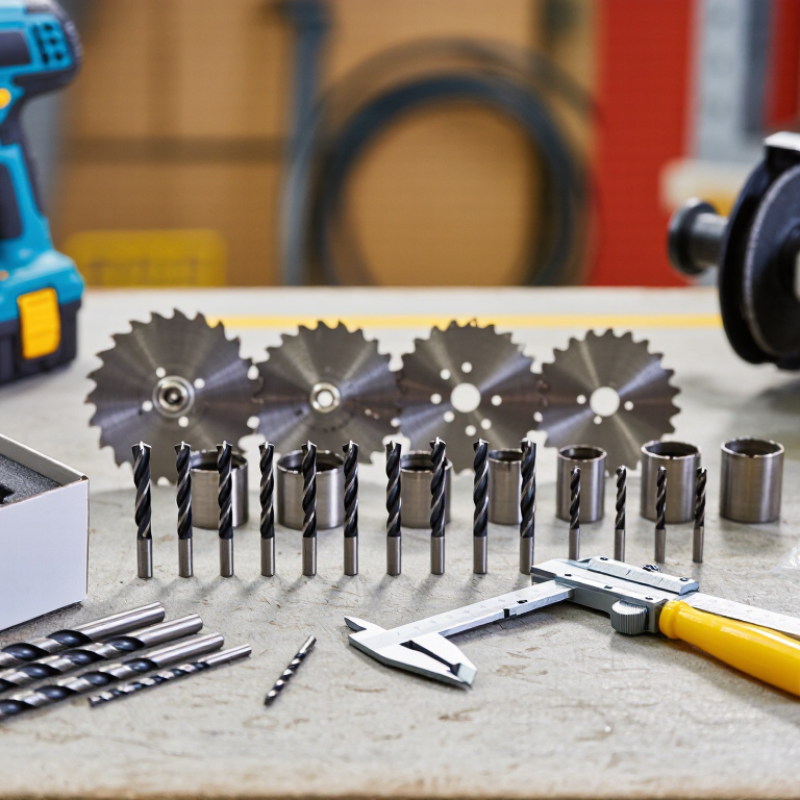
When choosing power tool accessories for global sourcing, inspect the material before comparing prices. High-speed steel suits general drilling, while carbide handles harder surfaces and longer production runs. For abrasive cutting, the abrasive grade, bonding method, and reinforcement deserve close attention. Ask for material certificates and batch records. Small differences in alloy content can change edge retention noticeably.
Safety checks should match real working conditions. Examine guards, shanks, connection points, and vibration levels during testing. A poorly balanced wheel may feel acceptable for five minutes but become tiring after an hour. Confirm clear operating instructions, traceable packaging, and consistent dimensional tolerances. Local requirements may differ, so technical documents should be reviewed by qualified personnel in each target market. Never treat a supplier’s test image as complete evidence.
Performance testing needs realistic samples, not only laboratory demonstrations. Test cutting speed, surface finish, heat buildup, and dust behavior with the intended tool. Measure results across several batches. One successful sample proves very little. Service life depends on storage, user technique, workload, and maintenance, so record these conditions carefully. My early sourcing checklist focused too heavily on initial sharpness. That assumption was wrong. A slightly slower accessory may deliver lower replacement costs and fewer interruptions. Still, service-life estimates remain imperfect when field data is limited. Request replacement-rate feedback from actual users, even when the numbers are inconvenient.
How to Choose Power Tool Accessories for Global Sourcing?
Compare Suppliers, Certifications, Pricing, and Minimum Orders
A reliable supplier should provide clear specifications, material details, and production photos. Request samples before discussing large purchase orders. Check fit, hardness, cutting performance, and packaging quality. A sample may pass testing but fail during repeated use. That gap matters.
Compare certifications carefully. Requirements differ by destination, product type, and intended application. Ask for current test reports, certification numbers, issuing laboratories, and product traceability records. Do not accept copied documents without verification. An experienced sourcing team should also review factory quality controls, inspection records, and corrective-action procedures. A factory visit can reveal more than a polished catalogue.
Pricing needs a wider lens. Compare unit cost, tooling charges, packaging, freight, payment terms, and inspection fees. A low quotation may hide weak materials or costly rework. Request prices at several order volumes, such as 500, 2,000, and 10,000 units. Minimum order quantities should match your sales forecast and storage capacity. Excess inventory ties up cash and may become obsolete.
Tips: Build a comparison sheet. Score quality, documents, lead time, communication, and price separately. Ask suppliers to explain every assumption. Keep written records. Small details prevent expensive misunderstandings, although even a careful process can miss an issue. Recheck critical data before production.
This practical sourcing model compares the factors most commonly reviewed during supplier qualification. Compliance readiness and product quality receive the highest weighting, while pricing, minimum order quantity, and lead time help control total procurement risk.
Choosing power tool accessories for global sourcing requires more than comparing unit prices. Start with a controlled sampling plan. Request production samples from several qualified suppliers, using identical drawings, materials, and performance requirements. Test fit, hardness, balance, coating, and packaging. Record every result with photos and batch details. Small differences can become expensive after thousands of units.
Quality control should continue beyond the first approval. Define inspection points for incoming materials, in-process production, and final packing. Use measurable tolerances instead of vague terms like “premium quality.” An independent inspection can add confidence, especially when factories are far away. Our early plan was too optimistic; one sample passed, but later batches showed inconsistent edge finishing. We now require repeat samples and random checks. Still, no system is perfect.
Tips: Keep a backup supplier for critical accessories. Confirm carton dimensions before booking freight. Prepare spare packaging materials locally when possible. Ask suppliers about lead times during peak seasons. Maintain a small safety stock, but review it regularly. Air freight may solve an urgent shortage, yet it can damage margins quickly. Sea freight is cheaper but needs longer planning. A written continuity plan should cover material delays, port congestion, rejected batches, and supplier capacity changes. Keep communication factual, dated, and easy to audit.