A Steel Metal Channel may look like a straightforward section: a web, two flanges, and a familiar shape. But choosing one by appearance alone can create problems. A channel that is too light may deflect under load; an oversized section can add cost and weight. Fit matters, too. Check how the member meets plates, brackets, fasteners, and nearby components.
Industry data shows the scale behind these decisions. World Steel Association’s World Steel in Figures 2024 reports global crude steel production of 1,888.2 million tonnes in 2023. The U.S. Geological Survey’s Mineral Commodity Summaries 2025 also tracks iron and steel production, trade, and scrap. These sources describe a vast, changing supply chain—not a guarantee that every size or grade is available locally. Verify current stock and material documentation with suppliers.
The right channel depends on its job. A frame supporting equipment needs different checks from a trim piece or cable support. Compare the required load, span, steel grade, corrosion exposure, dimensions, and connection details. Then review applicable engineering requirements with a qualified professional. Catalog dimensions can be helpful, but they do not replace calculations. Small detail. A clean fit on paper may still clash with a weld, bolt head, or installation clearance on site. That is easy to miss, and worth checking twice.
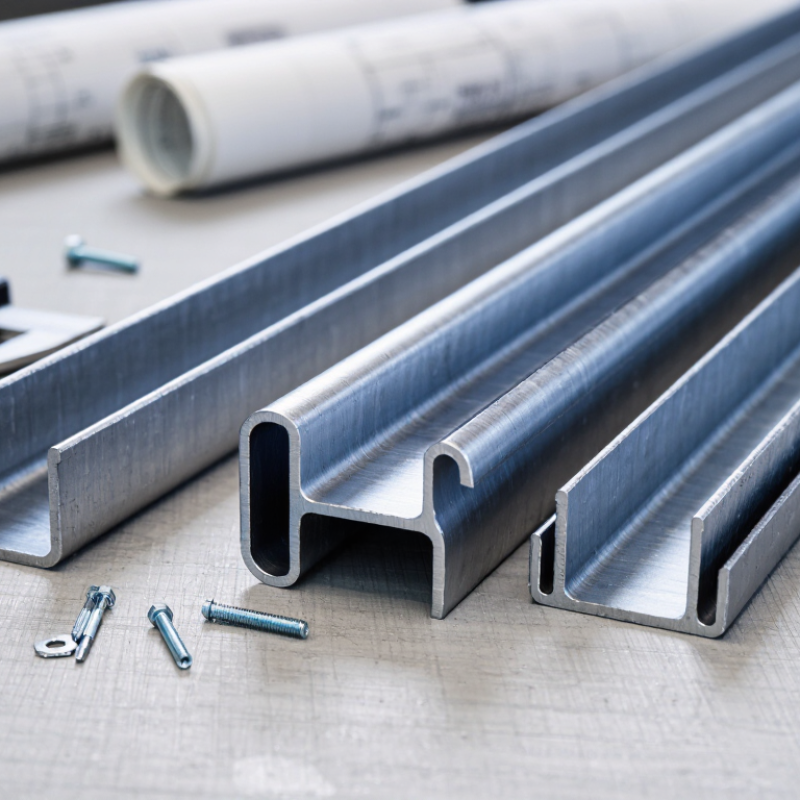
Before comparing steel metal channels, define what the part must do. Will it support a shelf, frame a partition, or carry a load across an open span? Note the channel’s length, support points, expected loads, and how often those loads may change. A short bracket and a long, lightly supported member can need very different sections. Measure twice. Record the available space too, including clearance for bolts, welds, and neighboring components.
Think about the conditions around the channel. Indoor, dry service may allow different corrosion protection than a damp workshop or an exposed outdoor installation. Check whether the channel will be cut, drilled, welded, or left with its original finish; fabrication can affect coating protection and fit. Be specific about dimensions, steel grade, and finish when requesting material. “A standard channel” is not a complete specification. It may be tempting to choose the thickest option, but extra weight and cost do not automatically solve a poor support layout.
For a load-bearing application, have a qualified engineer verify the section against the actual span, connections, and loading. Supplier tables can help narrow choices, but their assumptions may not match your project. One detail is easy to overlook: how the channel is oriented can change its stiffness substantially. Write down uncertainties, such as occasional impact or future attachments, before ordering.
| Project Requirement | Intended Use | Channel Type to Consider | Key Selection Checks | Practical Guidance |
|---|---|---|---|---|
| High load capacity and controlled deflection | Building frames, supports, lintels, or equipment bases | Hot-rolled structural steel channel, such as a C-channel or American Standard channel | Calculate loads, span, bending, shear, deflection, lateral stability, connections, and applicable building-code requirements. Confirm section dimensions and steel grade. | Structural channels are available in different depths, flange widths, and weights. A qualified engineer should size the member for the actual loads and support conditions. |
| Light-duty, adjustable support | Pipe, conduit, cable tray, and mechanical or electrical service supports | Slotted strut channel or back-to-back strut channel | Check the manufacturer-independent load tables for the exact channel profile, support spacing, cantilever length, fittings, and fasteners. Consider concentrated loads and vibration. | Strut systems are convenient for modular installations, but should not be assumed to replace a structural channel in a building frame without engineering verification. |
| Outdoor exposure and periodic moisture | External equipment supports, frames, and service racks | Hot-dip galvanized carbon-steel channel or a channel with a specified corrosion-protection system | Assess exposure, drainage, cut edges, drilled holes, coating damage, and compatibility with connected metals. Specify the required coating standard and thickness for the environment. | Galvanizing can improve corrosion resistance, but the appropriate coating depends on exposure severity, maintenance plans, and project specifications. |
| Humid, washdown, or chemically aggressive conditions | Food-processing areas, water-treatment facilities, and corrosive service environments | Stainless-steel channel or another corrosion-resistant material selected for the specific environment | Identify chemicals, concentration, temperature, cleaning agents, chloride exposure, and crevice conditions. Verify grade suitability and galvanic compatibility. | “Stainless steel” is not a single corrosion-performance category. Select the grade based on the actual service environment and applicable project requirements. |
| Known structural steel strength requirements | Load-bearing components where the project specifies a minimum yield strength | Structural channel supplied to the required material specification and grade | Verify the mill certificate, grade, applicable standard, section properties, thickness, and fabrication requirements. ASTM A36 and ASTM A572 Grade 50 are examples of structural steel specifications. | ASTM A36 commonly has a 36 ksi (about 250 MPa) minimum yield strength for relevant product forms; ASTM A572 Grade 50 specifies 50 ksi (about 345 MPa). Confirm product-form and specification applicability. |
| Limited clearance or a specific connection layout | Retrofits, machinery frames, brackets, and compact supports | Channel chosen to match the available depth, flange width, and connection orientation | Measure the installation envelope. Check bolt access, hole locations, edge distances, weld access, and whether the open section may twist under eccentric loading. | Channel sections are open sections and can be sensitive to torsion when loads are applied away from the shear centre. Include this effect in structural checks where relevant. |
| Frequent cutting, drilling, or field modification | Site-fabricated supports and assemblies with multiple connection points | Channel with a documented material grade and a finish suited to the fabrication sequence | Confirm weldability, cutting and drilling procedures, fastener compatibility, tolerances, and how protective coatings will be restored after fabrication. | Unprotected cut or drilled areas may corrode sooner in exposed service. Follow the project specification for repair of damaged coatings. |
| Project requirements not yet fully defined | Early design, budgeting, or comparison of potential channel options | Shortlist structural channel and strut channel options separately | Establish loads, span, support conditions, environment, design life, installation method, available space, applicable codes, and cost constraints before final selection. | Use this stage to identify candidate profiles only. Final sizing and material selection should be checked against approved calculations, standards, and project specifications. |
| Selection note: Channel dimensions, section properties, load capacity, and coating requirements vary by profile, steel grade, supplier specification, and jurisdiction. Confirm certified product data and have load-bearing applications reviewed by a qualified engineer. | ||||