A Handheld Portable Uv Lamp can look simple: a small light, a switch, and a rechargeable battery. The important details are less visible. Wavelength, output, beam shape, and intended use determine whether a model suits inspection, curing, or another specified task. Not all UV is alike. A lamp designed for one purpose may be unsuitable for another.
Photobiologist and health physicist David J. Sliney’s work highlights why UV exposure should be assessed carefully. A practical paraphrase of that safety principle is: “Judge UV by wavelength and exposure, not by visible brightness.” A bright glow does not prove strong or effective UV output. Buyers should check manufacturer specifications and follow the operating instructions. Keep UV away from eyes and unprotected skin, especially when using equipment that emits UV-C.
This guide compares ten portable models through practical buyer questions: What does each lamp claim to do? Are its specifications clear? How long does its battery last, and does its construction feel suited to regular handling? We also consider controls, charging, warranty information, and useful accessories. Details matter. No single lamp will fit every job, and product listings do not always make comparisons easy. The ranking is a starting point, not a substitute for checking the model’s instructions and intended application before purchase.
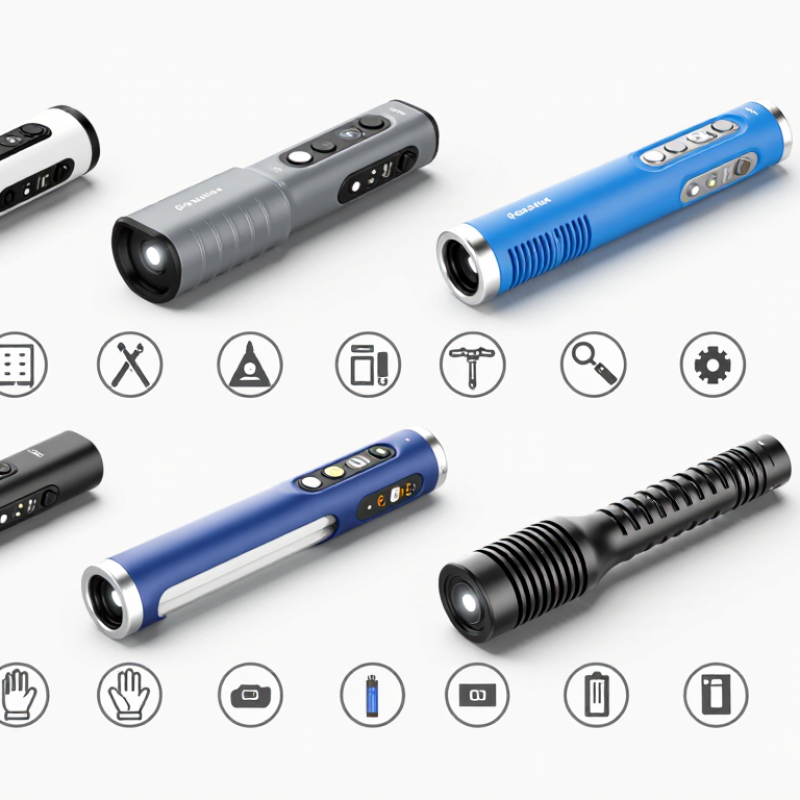
UV-C refers to ultraviolet wavelengths from 200 to 280 nanometers. A handheld lamp’s stated wavelength matters: two lamps can look similar while emitting different spectra. Check measured output, not just the color of the glow. UV-C is invisible.
Irradiance describes power reaching a surface, often measured in milliwatts per square centimeter. Dose is irradiance multiplied by exposure time; the result is expressed in millijoules per square centimeter. For example, 1 mW/cm² delivered for 10 seconds equals 10 mJ/cm². Distance matters. Moving a lamp farther away can sharply reduce the light reaching the target, while a tilted beam may spread it across a larger area. A calibrated UV-C meter can help verify readings at the actual working distance.
Dose alone does not guarantee a particular outcome. Required exposure varies by target, surface, wavelength, and test conditions. Dust, texture, and shadows can block UV-C; the underside of a curved handle may receive almost none. Real surfaces are messy. That is worth remembering when comparing product claims. Never aim UV-C at eyes or exposed skin, and follow the device’s safety instructions. A quick handheld reading may miss uneven coverage, so treat it as one measurement, not proof of performance.
A buyer-oriented comparison of common handheld UV-C wavelength and output profiles. The irradiance figures below are illustrative planning scenarios—not specifications or test results for particular products.
| Rank | Handheld lamp profile | Typical UV-C source / wavelength | Reference distance | Scenario irradiance at target | Time for 10 mJ/cm² | Time for 40 mJ/cm² | Buyer considerations |
|---|---|---|---|---|---|---|---|
| 1 | Compact, low-output LED wand | UV-C LED, 275 nm | 5 cm | 0.20 mW/cm² | 50 s | 200 s | Lightweight option for small, directly exposed areas; check beam coverage and measured irradiance at the working distance. |
| 2 | Entry-level multi-LED handheld | UV-C LEDs, 280 nm | 5 cm | 0.30 mW/cm² | 33.3 s | 133.3 s | Convenient for close-range use. Confirm the device emits UV-C at the stated wavelength, not visible violet light alone. |
| 3 | Focused short-wavelength LED wand | UV-C LED, 265 nm | 5 cm | 0.40 mW/cm² | 25 s | 100 s | Compare optical output, beam uniformity, heat management, and battery performance; wavelength alone does not establish treatment performance. |
| 4 | General-purpose 275 nm LED wand | UV-C LED, 275 nm | 5 cm | 0.50 mW/cm² | 20 s | 80 s | A common LED wavelength profile. Ask for irradiance measurement conditions, including distance, angle, and instrument calibration. |
| 5 | Higher-output LED handheld | UV-C LEDs, 270 nm | 5 cm | 0.60 mW/cm² | 16.7 s | 66.7 s | Useful output depends on illuminated area and uniformity. Check for thermal throttling and output changes as the battery discharges. |
| 6 | Wide-head UV-C LED wand | UV-C LEDs, 280 nm | 5 cm | 0.80 mW/cm² | 12.5 s | 50 s | A wider beam may cover more area, but verify irradiance across the full treatment footprint rather than only at the beam center. |
| 7 | High-output 275 nm LED wand | UV-C LEDs, 275 nm | 5 cm | 1.00 mW/cm² | 10 s | 40 s | Consider a trigger interlock, timer, shielding, and clear operating instructions; higher irradiance does not eliminate shadowing. |
| 8 | High-output 265 nm LED handheld | UV-C LEDs, 265 nm | 5 cm | 1.20 mW/cm² | 8.3 s | 33.3 s | Check independently documented spectral output and radiometric data. UV-C exposure can injure eyes and skin. |
| 9 | Compact low-pressure lamp wand | Low-pressure mercury lamp, approximately 254 nm | 5 cm | 1.50 mW/cm² | 6.7 s | 26.7 s | Traditional narrow-band UV-C source. Check lamp warm-up, breakage precautions, disposal requirements, and verified output. |
| 10 | Higher-output 254 nm handheld profile | Low-pressure mercury lamp, approximately 254 nm | 5 cm | 2.00 mW/cm² | 5 s | 20 s | Prioritize built-in safety controls and reliable dose measurement; do not use on people, animals, or exposed skin or eyes. |
UV-C fundamentals: UV-C conventionally spans 200–280 nm. Irradiance describes incident optical power per unit area; dose (radiant exposure) is irradiance multiplied by exposure time.
Calculation used: Dose (mJ/cm²) = irradiance (mW/cm²) × time (seconds). For example, 0.50 mW/cm² × 20 seconds = 10 mJ/cm².
Important: Scenario irradiances are chosen for illustrating dose arithmetic and are not measured or guaranteed product ratings. Actual irradiance varies with device, distance, angle, beam profile, temperature, and lamp age. Verify it with a suitable calibrated UV-C radiometer at the target surface.
A stated dose does not guarantee a particular disinfection result. Effectiveness depends on the organism, wavelength, surface, soil, exposure geometry, and shadowing. Follow applicable safety instructions and keep UV-C away from eyes and skin.